As a licensed Emergency Medical Technician (EMT) or paramedic, you have dedicated your career to providing urgent medical care to those in need. You have undergone an extensive certification and training process to be what you are now. You handle high-stress cases and put in long hours, and the work you do helps keep the community safe. However, a single formal complaint against you can ruin your livelihood, career, and all the hard work you have invested to build them, as the EMSA (Emergency Medical Services Authority) or your Local Emergency Medical Services Agency (LEMSA) can take action against your license.
For this reason, an official complaint that places your license in jeopardy can be extremely overwhelming. Before you know it, your whole career could be threatened. When in this position, you should consult an experienced professional license defense lawyer. At Santa Cruz License Attorney, we can help safeguard your license, career, and livelihood. Call us today to share your case details.
The Essential Roles of EMTs and Paramedics
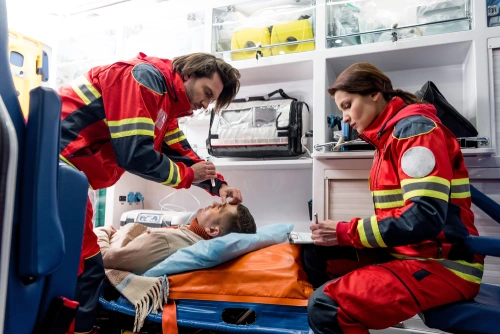
Medical emergencies occur unexpectedly, and in many cases, it is EMTs and paramedics who will respond to the scene first. Often, people fail to appreciate the trying and heroic work that emergency responders perform regularly. These professionals are frequently taken for granted until an emergency occurs.
EMTs generally work with hospitals, correctional facilities, and fire departments. They have undergone training to administer first aid to injured people and stabilize them before they can receive comprehensive medical attention. EMTs are also trained to handle a wide range of emergencies. They provide immediate medical assistance and support to individuals in critical conditions and offer care during traumatic emergencies.
In California, the law requires emergency medical technicians to maintain valid certification and undergo proper training to provide emergency medical services. Their primary duties include the following:
- Checking victims’ vital signs, such as breathing rates, blood pressure, and temperature
- Dispense emergency care, including:
- Restricting spinal motion
- Stopping bleeding
- Utilizing splints for injuries
- Performing CPR
- Assisting with normal and complicated childbirth
- Placing cervical collars to support the injured patients
- Administering certain medications
- Measuring levels of blood oxygen
- Managing oropharyngeal and nasopharyngeal airways.
Paramedics also work in hospitals and fire departments. They also work in correctional facilities, ambulances, and offshore or remote locations. Their responsibilities include the following:
- Assess patients’ illnesses and injuries in high-pressure settings. These include elderly and newborn patients.
- Administering medication (IV injections), performing CPR, managing airways, using defibrillators, and interpreting EKGs
- Immobilizing fractures, controlling bleeding, managing shock, and helping with childbirth
- Using and maintaining specialized equipment such as IV pumps and ventilators
- Transporting patients to hospitals, and providing ongoing care and comprehensive reports to hospital staff
- Interacting with distressed patients, relatives, and other emergency services.
- Working with other medical care professionals (nurses and general practitioners) to manage patients within the community, addressing psychosocial problems
Although both paramedics and EMTs share many core responsibilities, the primary difference lies in their level of training and the range of medical procedures they are authorized to perform. Paramedics undergo more extensive training and education, and they can provide a higher level of advanced life support care than EMTs. EMTs provide basic life support.
As a paramedic or EMT, every medical procedure you perform or drug you administer and all decisions you make ethically and legally bind you to higher standards of care. Your profession requires you to quickly analyze the most worrying situations, act faster, and make the most appropriate judgment possible for the safety and life of others. You must also accurately document all your actions and stay current with changes in medical procedures, medications, and laws that affect your role. A single oversight or mistake can threaten your career.
Overview of the EMSA Duties
California Health & Safety Code (HSC) 1798.200 gives EMSA and LEMSA the power to carry out investigations into paramedics’ and EMTs’ (respectively) off-duty and on-duty activities. This entails denying or granting licenses depending on violations. EMSA and LEMSA Enforcement Units are responsible for probing complaints against licensed paramedics and EMTs and unlicensed applicants for breaking the California HSC, Division 2.5, Emergency Medical Services.
The EMSA provides statewide leadership and coordination for the implementation, planning, and development of LEMSAs. Currently, California has 33 LEMSAs that offer emergency medical services across all California counties.
Actions That Could Jeopardize Your License
Among the most prevalent reasons for disciplinary action against an EMT or paramedic professional license is driving while intoxicated. DUI of drugs or alcohol, even if you are off work, can lead to you losing your practice license, but a skilled lawyer can assist you in obtaining the best possible outcome.
A conviction of any other crime related to the duties, qualifications, and functions of an emergency medical technician or paramedic can also cost you your professional license. There is a long list of such crimes, including sexual crimes, fraud, embezzlement, drug possession, and drug sale. Even if you do not have a criminal record, drug and alcohol abuse can jeopardize your license, particularly if you are dealing with substance addiction.
Any form of negligence or incompetence will also put your professional license in jeopardy, as will various types of misconduct, especially sexual misconduct towards a colleague or patient.
The EMT or Paramedics Disciplinary Process
The board disciplinary process for paramedics and EMTs begins when the board learns of a complaint against you. The complaint may be from a patient, employer, colleague, another board, a medical care facility, or other relevant parties.
Once someone files a complaint, the EMSA or LEMSA (whichever board applies) officials will first review it to determine its nature and whether the board has jurisdiction to process it. If the board has jurisdiction, it will send the complaint to its investigative division, and a thorough investigation will commence. When the investigation begins, the investigative officials will seek clarification from the party that filed the complaint, if necessary, and request a written response from you. If possible, the investigator may also question other witnesses.
Should the investigation reveal that there is considerable evidence against you or the complaint in question has merit, the board might offer you the chance to accept a stipulated agreement. A stipulated agreement refers to a legally binding settlement between the board, the state, and you, whereby you voluntarily admit to given violations and agree to particular disciplinary actions to resolve the case without an administrative proceeding. Since it is a legally binding settlement, you want to consult your lawyer before you sign anything.
If a stipulated settlement cannot be reached, or you opt not to agree to it, the board can send your case to the attorney general’s office for a formal action. The attorney general can then decide to file an Accusation or Statement of Issues against you. An accusation applies to license holders, while a Statement of Issues applies to new license applicants.
The attorney general will then notify you of filing either an Accusation or Statement of Issues, and you have 15 days to respond to the notice. You respond by filing a Notice of Defense. If you fail to file a Notice of Defense, it means you will not have the chance to defend your license against disciplinary action. That means the board will issue a default order against your license, leading to automatic revocation.
However, if you file a Notice of Defense, a hearing will occur. The hearing will be held before an administrative law judge (ALJ) at one of the Office of Administrative Hearings locations. Because this proceeding is legal in nature, equivalent to a trial in criminal court, you have the right to legal representation. You can also present your own witnesses, cross-examine those of the attorney general’s office, present your evidence, and disprove the attorney general’s evidence. The other side also has the right to argue their case.
At the end of the hearing, the judge will decide if the board should discipline you. You will have a chance to appeal.
Note that the board could dismiss an official complaint at any disciplinary process stage if it does not believe there exists adequate evidence. Based on the case facts, you can obtain this desirable outcome with assistance from a skilled lawyer.
Types of Discipline the Board May Impose
Losing your practice license and ability to earn a living practicing the profession you love is the most severe consequence. However, there are other disciplinary actions the board may impose against you. They are:
- Financial penalty or a citation. The board might impose a monetary fine or cite you. This is the least severe form of disciplinary action. Based on the type of violation and the case facts, the fine may range from $250 to $2,500. Usually, you must pay this fine by the sixtieth day after the board imposes it. However, your lawyer may negotiate for a more extended deadline by arguing financial difficulty where applicable. Fines and citations are only an option in a case where the violation did not result in the victim suffering harm. Although it is a lesser form of disciplinary action, a citation and a fine are public records. It will appear on the board’s website, allowing potential employers to view it.
- Written or verbal warning. If your violation is minor, the board might issue a private or public reprimand based on the case facts. A public reprimand is a public record. That means it will be available on the board’s website, and everyone can view it.
- Mandatory treatment. If your violation involved drug or alcohol abuse, the board may grant you the chance to enroll in a treatment program as an alternative to losing your license altogether. In this case, the board will stay your license suspension pending the completion of your program. If you complete the treatment successfully, you can continue to practice your profession. However, if you fail, your license will be suspended.
- License probation or restriction. The board may decide to bar you from particular services and activities, but permit you to still practice within those restrictions. The board may also impose other conditions on your license, and your retaining your license will depend on your understanding and compliance with all the imposed conditions. Your lawyer can negotiate probationary terms to make them as lenient as possible. They can also help you understand what precisely you must do when on probation and the punishment you will face if you violate the conditions. Lastly, your lawyer can negotiate to lower your probation period, qualifying you for early termination.
- License suspension. You may be subject to license suspension. A suspension prevents you from practicing your profession for a specific period, but with the likelihood of reinstatement upon a review. Your lawyer can negotiate for the reduction of the suspension period if the suspension is not preventable.
- License revocation. The board may also revoke your license. A revocation will prevent you from practicing permanently. In some cases, you may be eligible to reinstate your license; however, you will then need to undergo the application process again.
The EMSA Disciplinary Guidelines
The EMSA has published standard disciplinary guidelines against emergency medical technicians and paramedics across California. The objective of these guidelines is to ensure consistent and equitable discipline for professionals who have violated the law. They outline the factors that the EMSA must consider when determining what disciplinary action to impose. They include:
- The severity or nature of the allegations
- Whether the violation caused any actual harm
- The possible harm that the breach may have caused
- Whether you have prior warnings and violations
- Whether you have multiple violations
- Any mitigating or aggravating circumstances
- Whether you have a criminal history, the period that has passed since you committed the offense, and whether you followed court-ordered probation conditions
- In alcohol or drug abuse matters, whether the professional has undergone rehab
- Whether the EMT or paramedic employer has already ordered discipline. If so, the disciplinary action will be taken into account, thereby reducing the EMSA disciplinary action to a certain extent.
Contact a Skilled Healthcare Professional License Defense Lawyer Near Me
Do not take any chances with your paramedic or EMT license, career, and livelihood. If your license is under investigation or facing disciplinary action, the earlier you can consult an expert lawyer, the better. A qualified lawyer will start working on your defense right away, improving your chances of keeping your job.
At Santa Cruz License Attorney, we have healthcare professional license defense lawyers who understand the intricacies of the EMSA and LEMSA disciplinary processes. They will use this knowledge and their skill to secure the best possible outcome for your license. Call us at 831-770-6474 for a complimentary consultation.